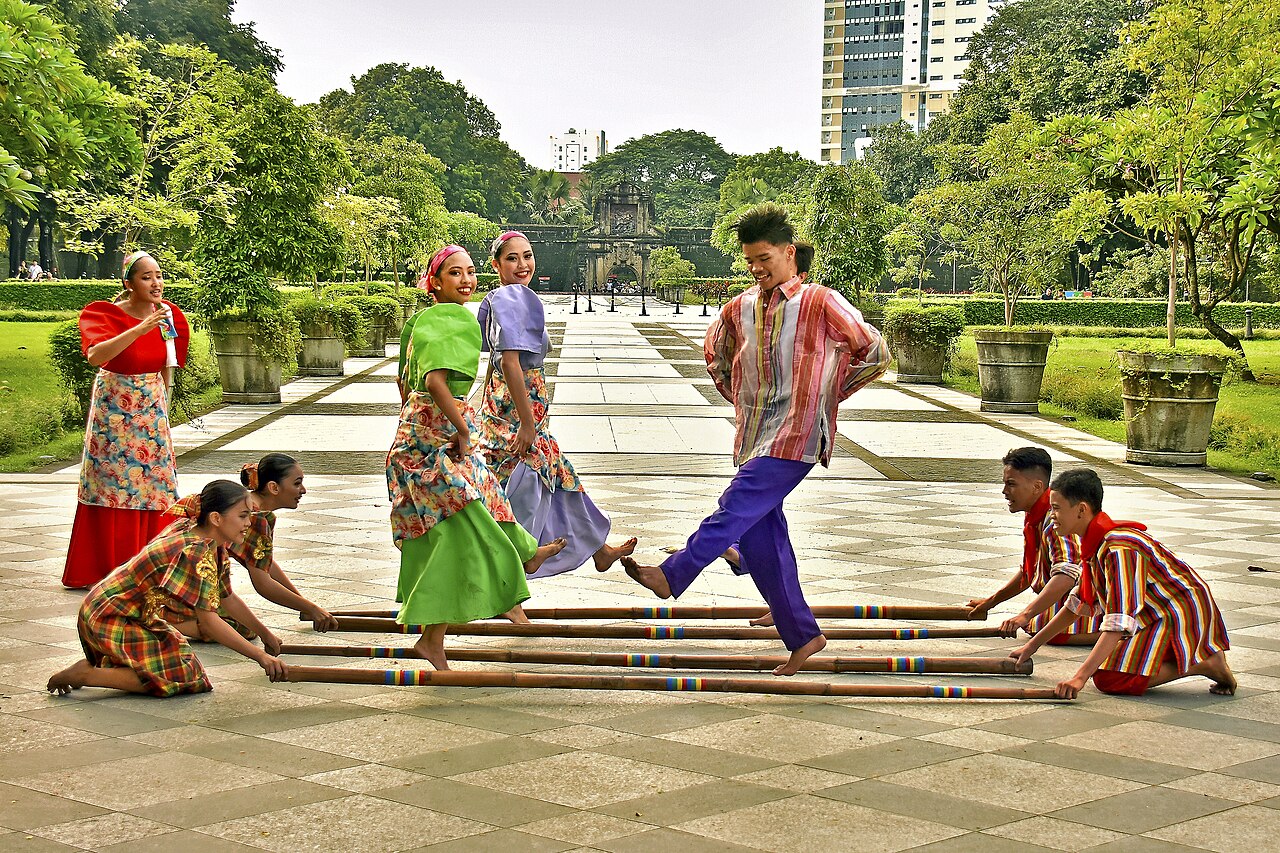
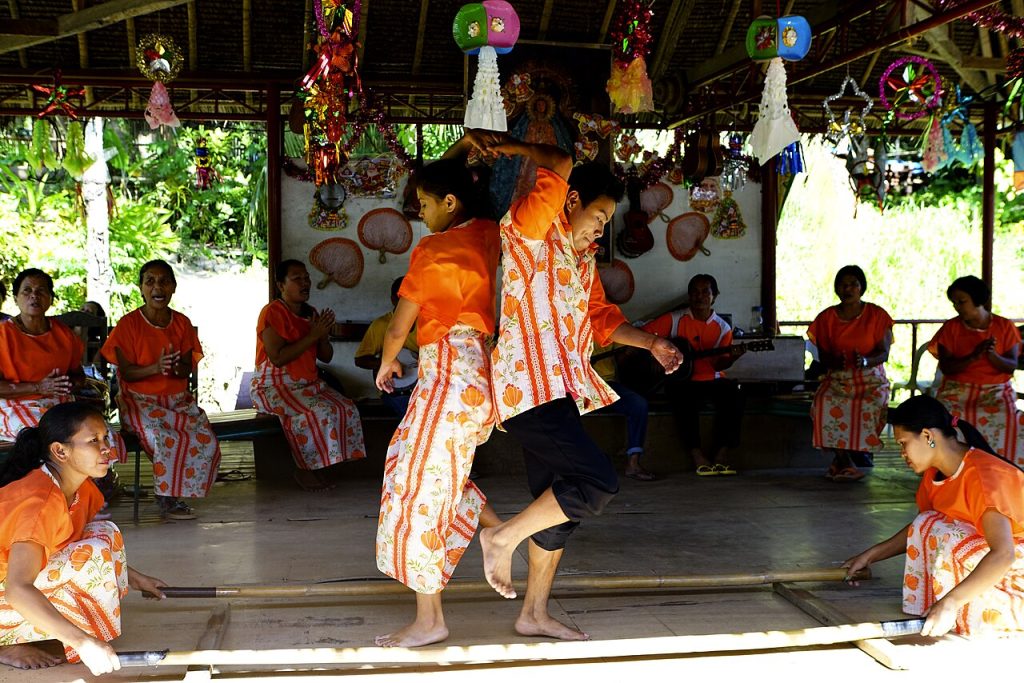
Almost every Filipino who went through grade school has a tinikling memory. Usually it involves a P.E. teacher counting out loud, two classmates crouched at either end of a pair of bamboo poles, and the real fear of a pinched ankle. The history behind the steps is far less tidy than the version most of us were taught, and the same is true of Singkil, the other famous Philippine dance built on clapping bamboo.
A bird, a rice field, and a story nobody wrote down
The name is the one part nobody argues about. Tinikling refers to the tikling, a bird of the rice fields, and the dance is generally described as imitating the bird stepping around the bamboo traps farmers set for it. Even the bird is less certain than it sounds, though. A Cathay Pacific travel feature identifies the tikling as the buff-banded rail. Kanami Namiki, writing in the University of the Philippines journal Asian Studies in 2011, glosses it as a heron and describes tinikling simply as “a game dance in which dancers dart in and out of clapped bamboo poles without their feet being caught.”
The trap story explains the footwork nicely, but no one recorded the first tinikling, so it is best read as the dance’s own explanation of itself. There is another version you will meet in classrooms and online, in which hacienda workers under Spanish rule were struck on the feet with bamboo as punishment and learned to dodge. We could not find that account in any primary or reliable source, and it should be treated as folklore, not history. The same goes for claims that tinikling was already being danced before the Spanish arrived. The Cathay Pacific piece states this flatly, but it offers no evidence.
Leyte is where the sources agree, and even there the details are disputed. In August 2006 the Philippine Information Agency reported that the municipal government of Tanauan, Leyte, had begun researching whether the dance began in their town. The question was prompted by a 2005 Philippine National Oil Company calendar, Sulyap, which said outright that “ang Tinikling ay nagmula sa Tanauan, Leyte.” Then-mayor Roque Tiu asked historians and culture workers for help. One local version placed the origin in Barangay Kiling and linked the village name to tikling, but the PIA release itself said that version “have yet to be authenticated.” Its conclusion: Leyte, yes; which town, still open. Other popular accounts name a different town altogether.
One more correction to the schoolbook version. Tinikling is often called the national dance, and the 2006 PIA release calls it the “National Folkdance of the Philippines.” But when the Inquirer reported in February 2014 on a House bill to formalize national symbols, it noted that even the cariñosa, the dance usually taught as the national dance, had never been recognized in law. We found no law designating tinikling either.
The woman who wrote the steps down
If tinikling feels standardized today, with the same counts and the same basic figures taught in school after school, much of the credit goes to Francisca Reyes-Aquino. Born in Bulacan on March 9, 1899, she began documenting dances in the barrios of Central and Northern Luzon, Rappler reported in 2019. Her 1926 thesis, Philippine Folk Dances and Games, was later adapted as teaching material for public and private schools. As a supervisor of physical education she pushed for folk dance to be taught as part of Filipino identity. She went on to publish Philippine Folk Dances in six volumes. She received the Republic Award of Merit from President Ramon Magsaysay in 1954 and was named National Artist in 1973.
A 2019 Lifestyle.INQ profile describes her as the first National Artist for Dance and says it was in Leyte that she came upon tinikling, along with other dances she taught through her books, such as the Maglalatik. The same profile quotes her: “Leave the folk dances as they are.”
Her influence is a big part of why so many Filipinos first meet folk dance in P.E. class. Namiki notes that the folk dance revival she led from the 1930s drew mostly on the dances of lowland Christian communities. That bias shaped which dances became “Filipino” in the school curriculum, and it matters for the next part of the story.
Bayanihan takes the poles abroad
The company that put tinikling on foreign stages grew out of the Philippine Women’s University. Namiki dates its formal founding to 1957 at PWU. A 2010 program note from Cal Performances at the University of California, Berkeley, credits Dr. Helena Z. Benitez with founding both the PWU Bayanihan Folk Arts Center and the Bayanihan Philippine Dance Company that year.
The turning point came before that. In 1954, Namiki writes, a PWU group went to the Asian Festival of Dance and Music in Dacca, then in East Pakistan, and performed Christian lowland dances accompanied by guitar. The delegation later recalled feeling like “outsiders, among fellow Asians,” an experience Namiki places at the root of the company’s later, broader repertoire. In 1958 the company appeared at the Brussels World’s Fair. Writing in Lifestyle.INQ in 2017, Virgilio A. Reyes Jr. recalled that PWU had to find sponsors and use its own funds to get its student dancers there. Philstar columnist Frannie Jacinto traced the trip in 2017 to a request from President Magsaysay. From there impresario Sol Hurok brought the group to the United States, including the Ed Sullivan show. According to the Berkeley program, Bayanihan made its Broadway debut at the Winter Garden Theater on October 13, 1959, and by 2010 had toured 55 countries. Tinikling was listed among its “all-time favorites” on that program.
Congress made the company’s status official with Republic Act No. 8626, approved April 15, 1998, which designated the Bayanihan Philippine Dance Company as the Philippine National Folk Dance Company and gave it a mandate to keep researching and documenting Philippine folk culture.
Singkil: same bamboo, different story
Tinikling is a rural game dance from the Visayas. Singkil comes from the Maranao of Lanao, in Mindanao, and the dance you have probably seen is partly a Bayanihan creation. That is not a slight. It makes the dance more interesting.
Today’s Singkil is widely known as a royal dance. A princess with fans and a prince with sword and shield weave through crisscrossed bamboo poles. Namiki’s account is more complicated. Henrietta Ele-Hoffer researched the dance with Bayanihan dance director Lucrecia Urtula in the mid-1950s. Her source was Bae Tarhata Alonto of Lanao, who handled three fans in each hand. (Bae is a Maranao title for a noblewoman, often translated as “princess,” though Namiki notes there is no exact English equivalent.) In Bayanihan’s reading the original was danced by women only. Bayanihan then set it to an episode of the Darangen epic, in which the prince Bantugan pursues the princess Gandingan while the diwata shake the earth in his way. Citing the scholar Trimillos, Namiki adds that the fan work was allegedly borrowed from a different Muslim dance tradition, the Tausug daling-daling of Sulu. The result, she writes, is “now the more recognized, iconic, and popular” Singkil, overshadowing “the far less-known original.”
Even the name has rival readings. Bayanihan ties it to the brass anklets worn by the original dancer. Sining Pananadem at Mindanao State University–Marawi reads it as entangling the feet with vines or anything else in one’s path. Ramon Obusan staged it as a wedding dance. Urtula, who choreographed Bayanihan’s dances, was later named National Artist for Dance, Philstar noted.
Side by side, the bamboo is almost the only thing the two dances share. One is a rice-field game standardized through textbooks; the other, a Mindanao dance reshaped for the world stage. Both are reminders to ask who chose a nation’s dances, and how.
Note: The exact town in Leyte where tinikling began is unconfirmed. The 2006 PIA release treats the Tanauan claim as unverified, and other popular sources name a different town. The bird and trap account and the hacienda punishment story are oral or popular explanations without documentary support that we could verify. The claim that tinikling predates Spanish colonization comes only from an unreferenced travel feature. We found no Philippine law declaring any dance, tinikling included, the national dance. The most recent report we could confirm on this was from 2014.
Sources
- Researchers probe possible origin of “tinikling” folkdance in Leyte — Philippine Information Agency (PIA 8), August 28, 2006 (archived copy)
- Hybridity and National Identity: Different Perspectives of Two National Folk Dance Companies in the Philippines — Kanami Namiki, Asian Studies vol. 47, University of the Philippines Diliman, 2011
- Google marks Francisca Reyes-Aquino’s 120th birth anniversary with doodle — Rappler, March 9, 2019
- How Francisca Reyes-Aquino sought and fought for our country’s folk dances — Amierielle Anne Bulan, Lifestyle.INQ, March 9, 2019
- At 61, Bayanihan keeps on dancing — Frannie Jacinto, The Philippine Star, November 14, 2017
- Ligaya Amilbangsa’s life reads like culture history and fairy tale — Virgilio A. Reyes Jr., Lifestyle.INQ, July 30, 2017
- Bayanihan, The National Dance Company of the Philippines (program notes) — Cal Performances, University of California, Berkeley, September 24, 2010
- Republic Act No. 8626 — Congress of the Philippines (via Lawphil), April 15, 1998
- Bill seeks to make adobo, jeepney, carabao as PH national symbols — INQUIRER.net, February 28, 2014
- How Filipinos are nurturing the traditional bamboo dance of tinikling — Cathay Pacific, undated