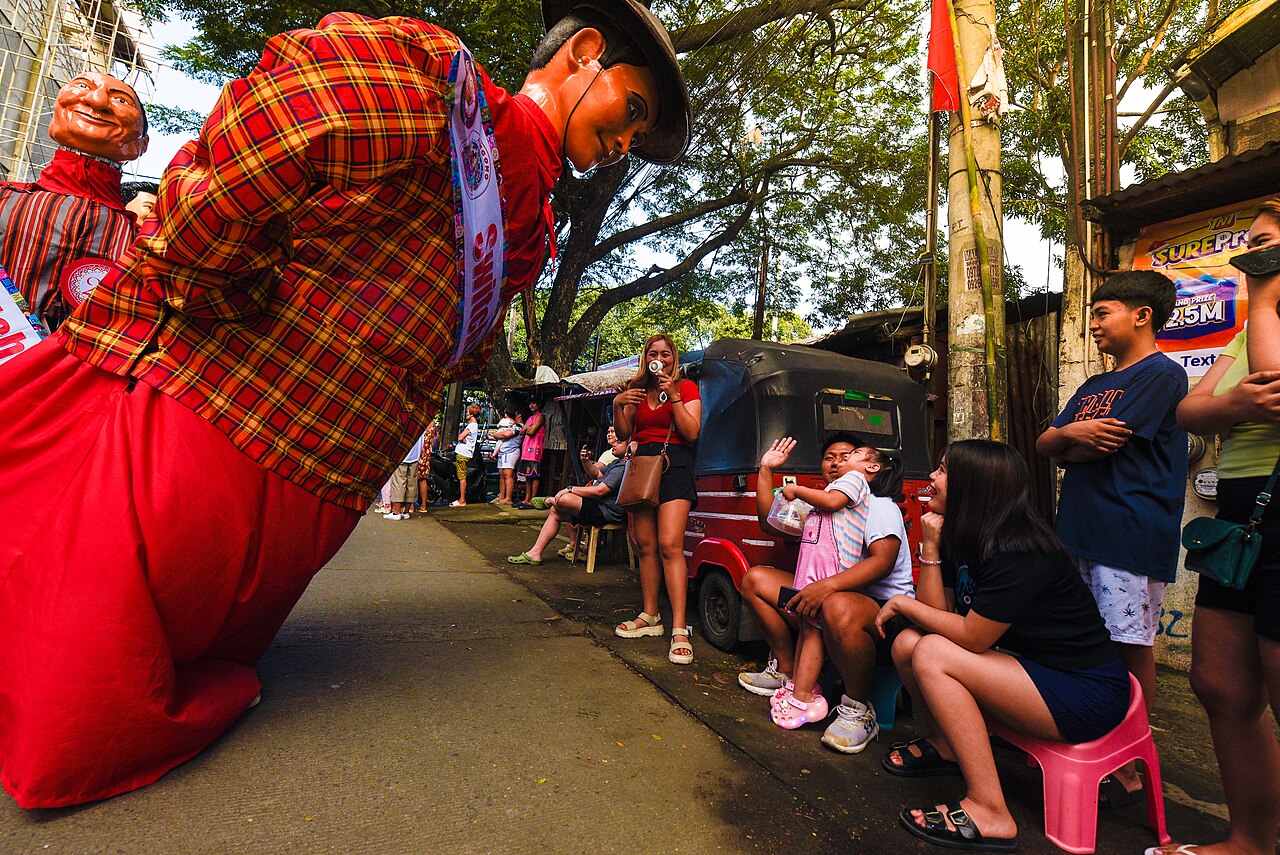
Angono’s giants have a look that’s easy to remember. They have big bulging eyes, a mouth that refuses to smile, and hands planted on hips like a foreman waiting for an excuse. That scowl is part of the story. In the version most townspeople grew up with, the first higante was a caricature of a landlord, and it was paraded through the streets so people could laugh at him.
Every November this lakeshore town in Rizal, which calls itself the Art Capital of the Philippines, sends dozens of these papier-mâché figures down its streets for the Higantes Festival. The giants are the reason most visitors come. They also carry a history that is more contested than the tourism brochures let on.
Two origin stories, and the town tells both
The Municipality of Angono’s own website gives the popular account first. According to Angono folklore, the higante was a symbol of agrarian protest during the last years of Spanish rule, when Angono was a hacienda. A 2012 GMA News feature describes the same tradition: peasants, angry at their Spanish landlord, made a giant in his likeness and paraded it in mockery.
Alejandro R. Roces, in a 2006 Philstar column, added detail. He wrote that the hacienderos allowed the townspeople only one fiesta a year. People made the most of it by building giant caricatures of their landlords, using an art form he said Spanish priests had brought from Mexico. The first set was a “Mag-anak” of father, mother and son. Roces also wrote that the Higantes Festival was conceived in 1897 by a Mr. Perdigon Bocalan. He said each of Angono’s 13 barangays later fielded three giants, for 69 in all.
The municipal site then gives a second, less romantic account. It cites a study by Far Eastern University professor James Owen Saguinsin. Saguinsin argues that the giant of the story was a real man: a tall hacienda caretaker, or katiwala, named Karias Tangkad, on whom residents wanted revenge (higanti). He also argues that the papier-mâché giants only began after World War II. In his account the painter Carlos “Botong” Francisco asked Artemio Tajan, the first higante maker, to bring some joy to the post-war fiesta. A 2014 Rappler photo essay names the same figure differently. It calls him Zacarias “Tangkad,” an abusive landlord known for his height and bad manners.
So was Tangkad a caretaker or a landlord? Is the tradition more than a century old, or post-war? The written record online doesn’t settle it, and it’s worth saying so. Roces’s 1897 date and its founder’s name also need checking. Rappler describes a “late artist Perdigon Vocalan” who founded the Balaw Balaw Restaurant and Folk Art Museum in Angono. That is a near-identical name for someone who could hardly have been active in 1897. They may be different people, or the date or name may have slipped somewhere along the way. What the sources do agree on is the turning point. Botong Francisco took a figure of ridicule and turned it into something festive.
Roces made one more point that is easy to miss. The higantes, he wrote, have nothing to do with the life of San Clemente, the patron whose feast they now escort. The town government is just as clear. It calls the Higantes Festival a secular celebration that the municipality started to give thanks to its patron.
Newspaper, paste and a hollow frame
A higante is mostly air, and that’s deliberate. Leonardo Tajan, Artemio’s son, explained to GMA News that the hollow body is made of assembled bamboo sticks to keep it light. The carrier climbs inside and walks the whole parade route. Their feet stay visible because the figure is lifted only about half a foot off the ground. Tajan said a full-sized higante takes about a month to finish. The head is the most detailed part and takes more than a week of that. He uses cellulose fiber to keep the papier-mâché firm. Without it, he said, the face would easily lose its shape.
Other makers use slightly different methods. Rappler reported that Angono’s giants are made from old newspaper, rattan poles and wheat paste. Elmer delos Reyes, a higante maker from Paete, Laguna, who learned the craft after arriving in Angono in 2005, prefers rattan poles he has reused for years. He considers them more durable than thin aluminum. Instead of casting new papier-mâché, he often gives old higantes a facelift, which saves time and material. Recycling is part of the tradition, not a shortcut around it.
Size varies by source and by figure. GMA measured the Tajan adults at about ten feet. A 2024 Daily Tribune feature puts parade giants at 10 to 12 feet. The cast has grown a lot. The municipality lists higantes of local and national officials, figures from Angono myths, and the vegetables from the folk song “Bahay Kubo.” It also lists the small giants called higantitos. Rappler noted datus, Augustinian missionaries and a San Clemente. GMA’s 2012 report spotted Moriones warriors and a giant Psy doing “Gangnam Style.” Sponsorship plays a part too: the Daily Tribune notes that companies and organizations traditionally sponsor higantes to represent them in the parade.
The Tajan family of giants
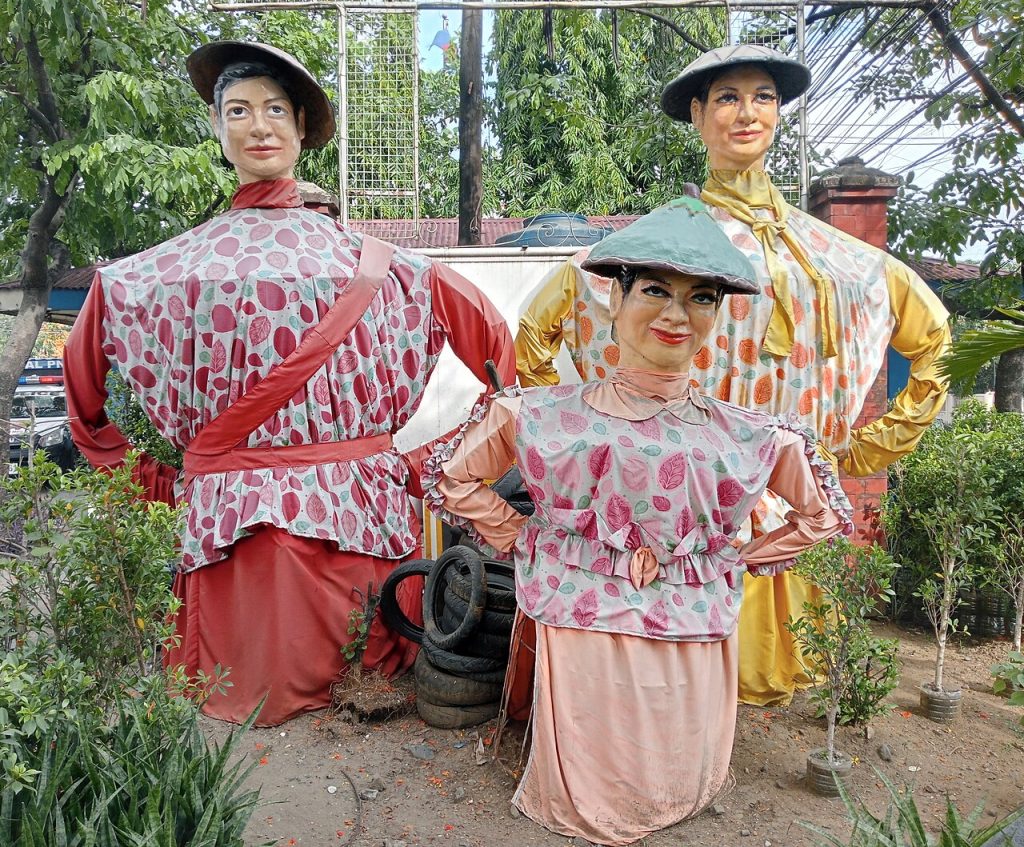
If any figures count as Angono’s founding giants, they are the Pamilya ng Higante made by Artemio Tajan. GMA News reported that the adult male in the set is the oldest higante still in existence in Angono. Tajan later made a wife to match, with the same wide eyes and her hair in a bun. For years the couple were the only higantes in the Pagoda, the religious procession for San Clemente’s feast. Then townspeople asked for a child. In the 1970s Tajan made a boy about half their height. The wife wears baro’t saya, and the father and son wear long-sleeved shirts and trousers.
The family has also become practical. GMA reported that the three are painted on one of the town’s river dikes, tallest to smallest, with depth markings so residents can read rising floodwater against them. Leonardo Tajan, a barber by trade, kept up his father’s originals and has made new giants of his own, including commissioned pieces of the town’s mayor and vice mayor.
Today the craft is spread across many workshops. Rappler reported that higante maker Toti Argana owned about a hundred figures. The Blanco Family Museum shows its own collection next to the family’s paintings. The studio at Balaw Balaw is where delos Reyes works on heads in the weeks before the fiesta.
When the giants come out
The fixed point is 23 November, the feast of San Clemente, whom Roces and the Daily Tribune describe as patron of fishermen. On the feast, Roces wrote, the saint’s image is carried around town to Laguna de Bay and back to the church. His escorts are children in costume carrying boat paddles and wooden bakya. Roces calls them parehadoras, and the Daily Tribune spells it pahadores.
The big higantes parade usually comes before the feast day, not on it. The municipality says the parade of giants is held on the Sunday before 23 November. Its own report on the 2017 edition fits that pattern. More than 100 higantes paraded on Sunday, 19 November 2017, setting off at 7 a.m. from Rainbow Village/SM Center Angono and ending at the Angono Municipal Compound. For 2024, the Daily Tribune reported the parade would start on 17 November, the Sunday before the feast. Rappler’s 2014 piece gives “November 22–23” as parade days. Treat that as a sign that the schedule has shifted over the years.
The festival itself has also grown longer. In 2023, municipal public information chief John Robert Ducabo told the Daily Tribune that the celebration might run from 31 October to 25 November. He said it would include exhibits, pageantry, music, an itik (duck) cooking competition and sports, with the grand parade near the end. If you plan to go, check the Municipality of Angono’s announcements for the current year before you travel. Weather and local decisions can move the parade.
Note: The origin of the higantes is disputed. The colonial-era protest story is oral tradition, and the post-war account comes from a study we know only through the municipality’s summary. We could not access the original Saguinsin study, and we could not confirm Roces’s 1897 date or the identity of “Perdigon Bocalan.” Manila Bulletin coverage of the 2024 and 2025 festivals, including reports that the 2024 parade was postponed because of a typhoon, could not be retrieved, so it is not used here.
Sources
- Home of the Higantes Festival – Angono, Rizal — Municipality of Angono, undated
- Higantes Festival grand parade in Angono, Rizal, Sunday morning, Nov. 19, 2017 — Municipality of Angono, November 2017
- The art and life of Angono’s higantes — GMA News Online, 24 November 2012
- Angono’s Higantes Festival: How giants are made — Rappler, 21 November 2014
- The Higantes of Angono, the Higantes of today — Alejandro R. Roces, The Philippine Star, 23 November 2006
- Higantes Festival: Angono’s towering tradition — Daily Tribune, 14 November 2024
- The Higantes Festival a celebration of art, culture, and tradition — Daily Tribune, 24 November 2024
- Grander Higantes Festival slated — Daily Tribune, 9 October 2023