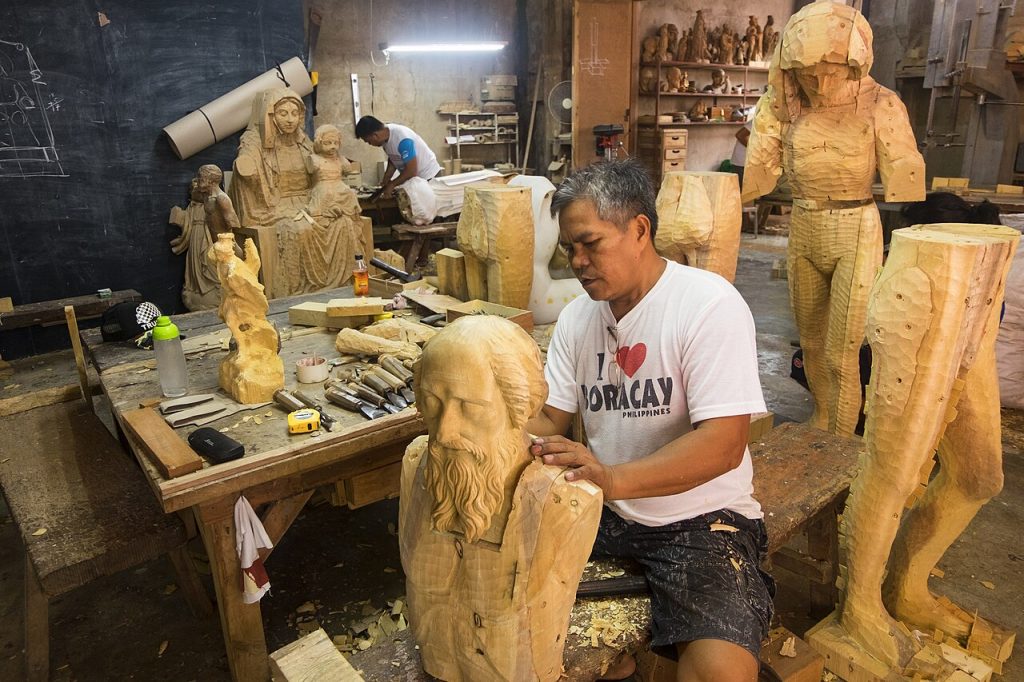
In 2019 Paete had about 900 woodcarvers. That figure came from the town’s municipal agriculture officer, Antonio dela Rosa, speaking to the Philippine Daily Inquirer. He estimated that 3,000 to 5,000 people carved in the 1970s and 1980s. The town keeps no official registry, so both numbers are rough. They still say more about Paete than its title does.
The title is real. Proclamation No. 809, signed by President Gloria Macapagal-Arroyo on March 15, 2005, declared Paete the “Carving Capital of the Philippines.” It says the town takes its name from paet, the old Tagalog word for chisel. It credits Paete’s artisans with “countless statuaries, architectural embellishments and souvenirs.” The town government describes Paete as a fourth-class municipality on the eastern shore of Laguna de Bay with more than 25,000 residents. Its identity, the town says, rests on woodcarving, papier-mâché and the visual arts.
So Paete is small, it still works for a living, and it makes two very different things: saints carved from wood, and horses made of old newspaper.
Saints by the foot
The core of the trade is religious images. The Inquirer’s 2019 report describes the wooden statues and crucifixes “found in almost every Catholic church and home in the country” as usually made in Paete. Workshops still line the downtown streets, and smaller ones run out of carvers’ homes.
Justino “Paloy” Cagayat Jr. is one of the names that comes up most. He is a third-generation carver. In a 2013 Inquirer interview he said his grandfather Dionisio won first prize in woodcarving at the 1924 Manila Festival. At the time his shop employed 17 craftsmen, and he said work doubles in the run-up to Holy Week. His most-ordered pieces were figures from the Passion: Maria Magdalena, Maria Cleofe, Maria Salome and the crucified Christ.
Another is Luisito Ac-ac, described in the 2019 report as an apprentice of National Artist for Sculpture Napoleon Abueva and a 2009 nominee for National Artist. He opened Museo Ac-ac in 2017 to show his work. The same report gives a sense of price in 2019. A two-foot statue, clothed, cost ₱8,000 to ₱10,000, and a life-size image ₱50,000 to ₱60,000 with clothes and ornaments. Ac-ac’s own work ran ₱20,000 to ₱25,000 per foot, and a five-foot statue took him about a month.
The wood carvers prefer is batikuling (Litsea leytensis). Cagayat told the Inquirer it is soft and light and has a smell that repels termites. The tree grows mostly in Quezon and parts of Laguna, and supply is the industry’s biggest headache. Carvers blamed the 2011 log ban under Executive Order No. 23. “We were not given special permit to harvest wood,” Cagayat said, even with the Carving Capital title. Shops now also use santol, mango, acacia and narra. In 2013 the municipal government and Southern Luzon State University began planting batikuling. By 2019 the plantation covered 15 hectares, and the trees needed another 15 to 20 years before harvest.
Labor is the other problem. Many trained carvers went abroad to carve ice, fruit and vegetables on cruise ships and in hotels, where the pay is in dollars. “There are only a few of us left who carve saints,” Cagayat said in 2019. He noted that carving was being brought into the senior high school curriculum, with students placed in local shops.
Paper horses from wooden molds
Paete’s second craft gets less credit. Taká is papier-mâché built over a carved wooden form called a molde. Newspaper and paste are layered over the mold, dried (in many workshops, in makeshift ovens) and then painted. Rappler’s 2022 feature on the Adao family repeats the origin story told in town. A couple decorating the church for Christmas found that the wooden nativity figures were so heavy they kept falling over. They molded paper copies from the carvings instead, and that is basically how taká is still made. Treat it as local tradition rather than documented history.
Taká work has mostly been done by women, often in small workshops beside the house. Ka Ichu, a magtataká for decades, told Rappler that she started in the 1980s because the money was good: cheap materials, high prices. In a 2026 Rappler follow-up she said her family began supplying large decorative pieces to Rustan’s and SM and, by 1992, exporters. Orders stayed strong until around 2005. Some unfinished pieces went to the United Kingdom, where they were sold as paint-it-yourself kits. Buyers have since moved from flowers and leaves to animals. She also blamed cheaper, faster production from China for pulling prices down.
Her daughter, the artist Rizia Adao, started Taká ng Paete in 2022 under the hashtag #KeepTheTakaAlive. She told Rappler there may be as many magtataká (taká makers) in Paete as woodcarvers, if not more, yet few outsiders know the word. In her own experience, she said, only about 10 percent of a piece’s selling price reaches the makers. That is her estimate, not an industry survey, but it helps explain why younger people hesitate to take the craft up.
The church at the center of it
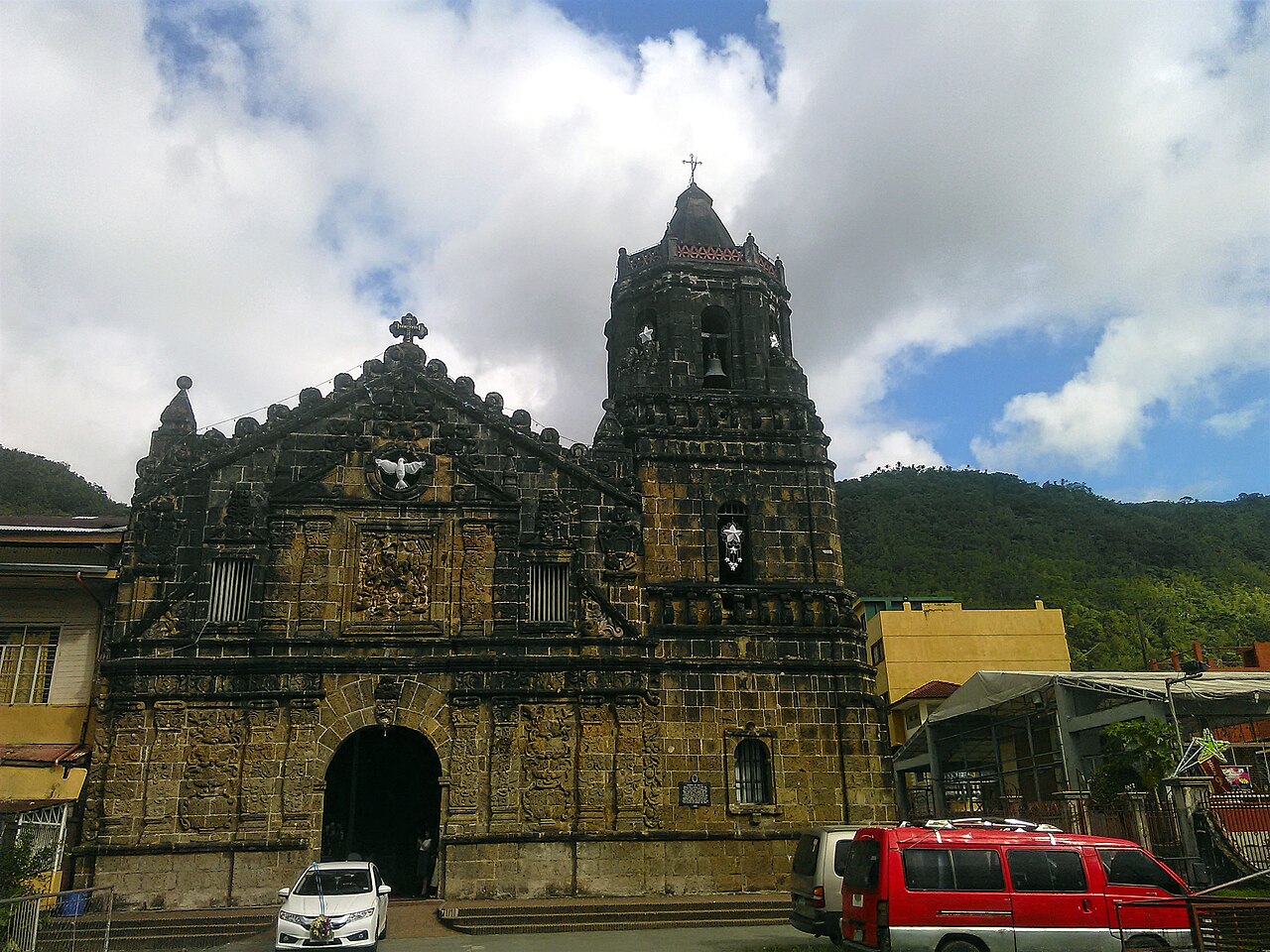
The Parish of Santiago Apostol (St. James the Apostle) explains why so much of the town’s art is religious. The writer Jose “Butch” Dalisay, in a 2010 column, gave 1646 as the year it was built, though other dates circulate.
The church’s best-known works are its large wall paintings near the main entrance. Dalisay described a towering Langit, Lupa at Impyerno (Heaven, Earth and Hell) on one side and San Cristobal (St. Christopher) carrying the Child Jesus across a river on the other. Two murals, he wrote, are attributed to the local artist Jose Luciano Dans and dated 1850. A third, a fresco found when the San Cristobal panel was lifted, is unsigned. In December 2015 the National Museum’s list of new National Cultural Treasures included the “Sacred Art of the Parish Church of Santiago Apostol in Paete, Laguna (four paintings in situ),” as reported by The Philippine Star. Dalisay’s 2010 column described serious decay, including rotted wood under the San Cristobal.
Holy Week is when the carving and the church meet in public. Speaking on GMA’s 24 Oras in April 2025, Rex Estores of the parish’s historical and cultural heritage ministry said Paete’s procession of “moving saints” dates to the 18th century. The image of Sta. Veronica moves its head, arms and hands by strings. According to Estores, only certain Paete families know how to work and maintain the mechanisms. The same report said the Mater Dolorosa was carved by Mariano Madriñan in 1882, shown at an international exposition in the Netherlands, and recognized by King Alfonso XII of Spain. ABS-CBN reported that on Holy Thursday 2025, townspeople playing Roman centurions in carved wooden masks paraded through the streets for the senakulo.
Seeing the craft for yourself
Paete is a working town, so the best way to see its art is to visit at the right time and buy something. The 2019 Inquirer report said carvers are busiest in the months before Holy Week and Christmas, and that June and July are usually slow. Holy Week brings the processions. The town’s Ukit-Taka Festival, which celebrates both crafts, fell in late September in 2026. Rappler reported that a Matutong Magtaká workshop, where participants pressed paper onto horse molds under Ka Ichu’s guidance, was held on September 27 that year to coincide with it. Dates shift, so check the municipality’s announcements.
The shops on the inner streets sell everything from Sto. Niños to, as Dalisay noted in 2010, Marilyn Monroes. If you want a commissioned santo rather than a souvenir, workshops expect orders well ahead of Lent. Cagayat said in 2013 that he asked clients to order before Christmas and still had to turn work away. For the paper craft, the Adao family’s Takang Paete put together a DIY kit, if it is still being sold. Rappler’s 2022 story describes a red horse, its wooden molde, newspaper, paste, a cutter and paints in one box.
Wherever you buy, ask who made the piece. In every account cited here, from the Cagayat workshop to the Adao family’s taká business, families are what kept the chisel and the paste pot going. Their names are worth knowing.
Note: The founding date of the Paete church differs between sources, and we could not check it against parish, diocesan or National Historical Commission records. The name of the person usually credited with inventing taká could not be confirmed from a primary source. We found no published report after 2010 on the condition of the church murals. The carver numbers and statue prices come from a 2019 report and may be out of date.
Sources
- Proclamation No. 809, s. 2005: Declaring the Municipality of Paete, Province of Laguna, as the “Carving Capital of the Philippines” — Office of the President (text via The Lawphil Project), March 15, 2005
- Paete, Laguna — Bayan ng Sining, Pananampalataya, at Pagkakaisa — Municipal Government of Paete (Paete.TV), July 9, 2025
- Wood carving art alive in Paete — Kimmy Baraoidan, Philippine Daily Inquirer, April 28, 2019
- Lent brings brisk business to Paete wood-carvers — Tarra Quismundo, Philippine Daily Inquirer, March 31, 2013
- Hold your horses! How a do-it-yourself taká kit keeps Paete’s papier-mâché art alive — Amanda T. Lago, Rappler, February 5, 2022
- Passed from hand to hand, Paete’s taká tradition looks to its next generation — Arabella Grace Sta. Ana, Rappler, October 10, 2026
- Save the Paete murals — Jose “Butch” Dalisay (Penman), The Philippine Star, April 19, 2010
- National Museum bares 2015 list of cultural treasures, properties — Alixandra Caole Vila, The Philippine Star, December 25, 2015
- Famous moving saints showcased in Paete, Laguna — GMA Integrated News, April 16, 2025
- Holy Week traditions remain alive in Paete, Laguna — Maria Tan, ABS-CBN News, April 19, 2025