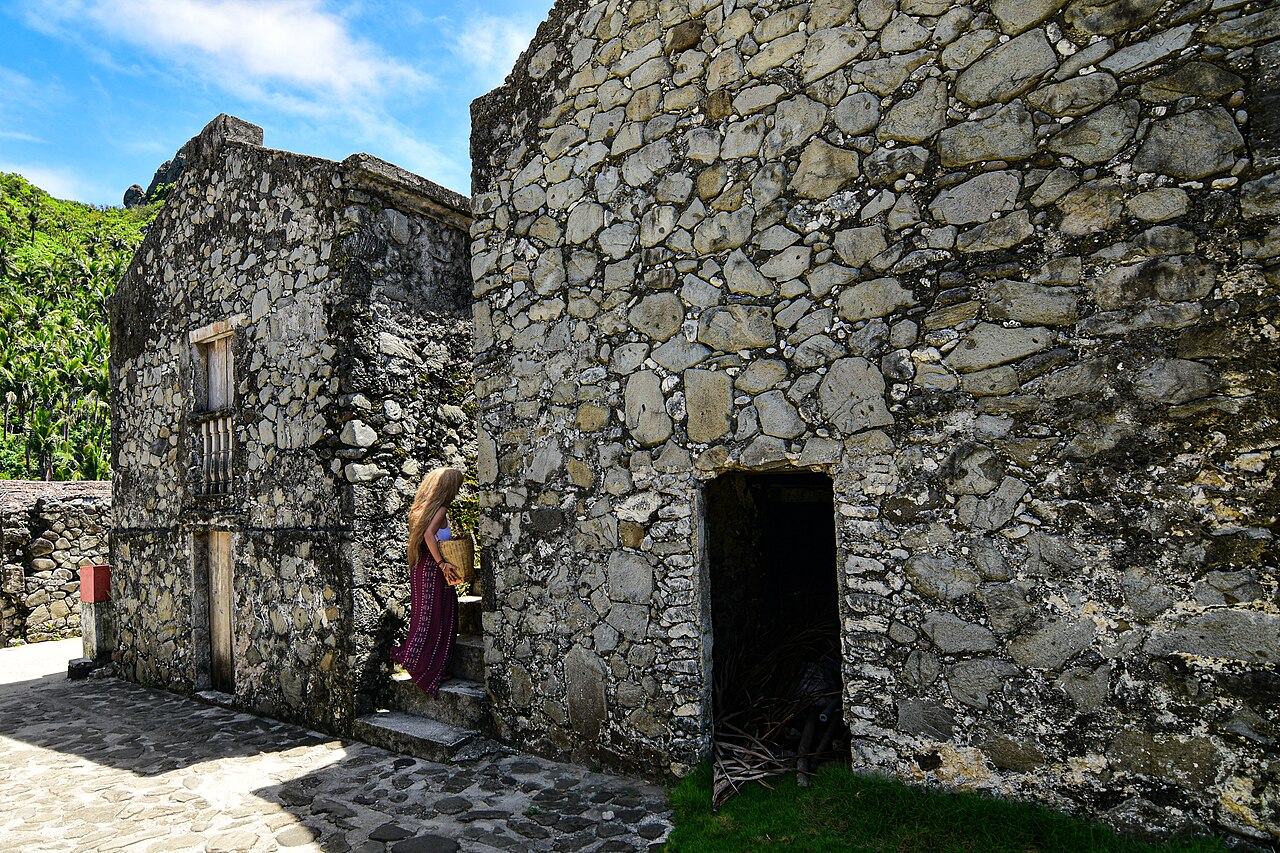
Elsewhere in the Philippines, village houses have usually been built of wood, bamboo and thatch. In Batanes the traditional house is stone. That contrast is spelled out in the entry the Philippines placed on UNESCO’s World Heritage Tentative List on August 15, 1993, under the name “Batanes Protected landscapes and seascapes.” The entry calls the province “the only area in the Philippines where traditional architecture is of stone in response to the wind and monsoon stresses.” More than three decades later, Batanes is still on that list and still not inscribed. The houses themselves are getting harder to keep up.
Basco’s airport is on Batan, and so are some of the best-known houses, such as the House of Dakay in Ivana. Some of the best-preserved villages, though, are across the channel on Sabtang, the smallest of the three inhabited islands. GMA News writer Nikka Corsino described the crossing in 2013 as a 30-minute ride over the Balintang Channel on a faluwa. It is a wide boat with no outriggers, built to ride the waves rather than fight them.
Lime, stone and a yard of cogon
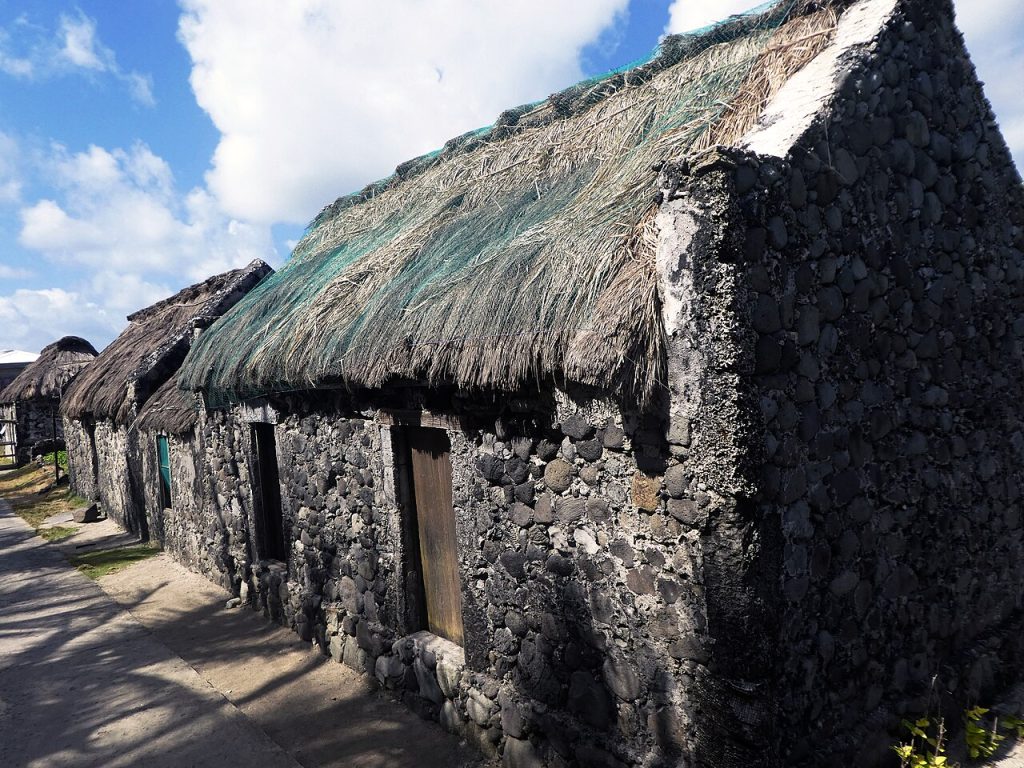
According to Batanes’ Provincial Heritage and Tourism Office, the classic Ivatan house has walls of lime and stone and a thick roof of cogon grass. On Batan and Sabtang the builders used cut stone. On Itbayat, which has few regular-shaped stones, walls were built of very irregular, rough rock. A house usually turns a blank wall toward the direction typhoon winds come from. Doors and windows are narrow, with wooden shutters that are barred during storms. Many houses have two floors. In stormy weather the lower floor sheltered the family’s animals, and people lived upstairs.
Corals went into some walls too. In a 2005 AFP report carried by The Philippine Star, Florentina Estrella, then 79, said her grandfather built her house in Ivana from corals washed up on the shore and stones from the coast. The report described its walls as about a meter thick. The mortar was made by hand. In a December 2025 GMA News report, Priscilla Cabugao, a 76-year-old heritage volunteer in Uyugan, described how the elders cooked limestone and wood overnight to make the lime that binds the walls.
The roof is where the real work happens. The tourism office says a new cogon roof can be about a yard thick. That thickness keeps the house cool from April to June and warm from December to February, and a roof lasts 25 to 30 years with minimal repair. Before a typhoon, families throw a net of heavy rope, the panpet, over the whole roof and tie it to pegs, large stones or trees. Cabugao told GMA that she has never seen a traditional house truly destroyed by wind “as long as it’s properly tied.” Her worry was the sea. Storm waves had come into her kitchen three times.
Not all Ivatan building shares that resilience. When twin earthquakes of magnitude 5.4 and 5.9 struck Itbayat on July 27, 2019, the provincial government estimated that 80 traditional stone houses were in ruins, GMA News reported. The houses, GMA noted, have no steel reinforcement.
Sinadumparan or maytuab: read the roofline
Visitors usually hear two type names, and the roof tells them apart. The tourism office’s typology draws on the work of the Ivatan ethnohistorian Florentino Hornedo. It defines the sinadumparan as a house with a two-sloped roof, whether it is the main living house (rakuh) or the kitchen house (kusina). The maytuab has a four-sloped roof. The office calls the maytuab the most labor-intensive of all Ivatan vernacular houses, because it takes a huge volume of cogon.
Writers do not describe the types identically. In a July 2026 Daily Tribune essay, Albert Julius Valeros Aycardo described the sinadumparan as a low one-storey house whose storage level may sit partly below ground. The rakuh, in his account, is more clearly two-storey. He tied the stone house to the Spanish administration set up in 1783, to large-scale lime production and to craftspeople brought in from Cagayan. Architect Jose F. Ignacio’s survey, he wrote, treats it as precolonial Ivatan building combined with the mainland bahay na bato.
Construction dates of individual houses also vary. The House of Dakay in Ivana, probably the most photographed house in the province, was built in 1887 according to the tourism office. The 2005 AFP report, describing the Ivana house Estrella said her grandfather Jose Dacay built, also gives 1887. A December 2025 GMA News special gives 1877. The tourism office and GMA agree that it survived the 1918 earthquake.
Savidug and Chavayan, across the channel
Corsino’s 2013 piece describes the trip south from Sabtang’s town center on a cogon-roofed tricycle. The cliffside roads lead to Savidug and Chavayan, “two towns that promised sights of well-preserved stone houses.” Her visit came just after Typhoon Odette, and she found Savidug looking “lonely.” Chavayan had narrow alleys and “the most stone houses I have yet seen in a single area,” with doors and windows painted in bright, solid colors.
The provincial tourism office calls Chavayan “the cradle of Ivatan culture and heritage,” known for rows of old houses and narrow streets. Its Sta. Rosa de Lima Chapel was built in 1951 through yaru, a community work effort. It has meter-thick lime walls and, according to the office, is the only church in Batanes still roofed with cogon. Savidug’s main listing is its ijang, an old hilltop fortress settlement. The office considers it the most beautiful and perfectly shaped in the province. In Sumnanga, further along the island, the office says the remains of Ivatan houses are being restored.
These are lived-in barangays, not museums. Visiting with an accredited local guide is the sensible way to go. The provincial tourism site lists DOT- and province-accredited guides and drivers. It also says the only way to reach Batanes is by air. Philippine Airlines flies from Clark to Basco, and Sky Pasada flies from Tuguegarao.
Heritage status on paper, and the people doing repairs
The tentative entry, submitted in 1993 by Augusto F. Villalon with MAB Philippines and the Protected Areas and Wildlife Bureau, is still listed on UNESCO’s site. In 2005 AFP reported that the islands had been nominated and that a decision was expected that year. In 2011 The Philippine Star reported, citing the Philippine Information Agency, that Batanes was trying again after “failing for the past five years.” Florentino Hornedo, then a Philippine commissioner to UNESCO, said in that report that inscription would depend on how committed the province’s leaders and residents were to preserving their own heritage.
The pressure on the houses comes from ordinary life. GMA News’ December 2025 reporting from Uyugan, on Batan, found that no new traditional houses are being built there, only re-roofings. Only about 25 cogon-roofed houses remained in the town center. Residents said protected-area rules now restrict lime-making and the cutting of some beam woods. Cogon is scarce, and younger families prefer concrete houses that take up less of a small lot. Cabugao is secretary of the Kamañidungan association, about 26 families bound by sidong, the Ivatan ethic of mutual help. The group re-roofs houses between March 15 and September 15 and can manage two living rooms or two kitchens a season. Some families have switched to nylon rope, which holds but does not last as long.
The official response so far is a hybrid. In December 2025, the Department of Science and Technology’s PCIEERD and Cagayan State University turned over a Modern Resilient Ivatan House in Uyugan. It has stone outside, concrete inside and a steel roof shaped like cogon. The Sangguniang Panlalawigan endorsed the designs in Resolution No. 73, series of 2024, and the resolution names the Ivatan as the cultural owners of the traditional house. Others in the community, GMA reported, worry that imitation is not preservation.
That reporting comes from Uyugan, not Sabtang, but the same lime, cogon and labor hold up the walls in Savidug and Chavayan. The houses there are worth the crossing. They last only as long as someone re-roofs them.
Note: We could not find a current, primary-source account of conditions in Savidug and Chavayan. The village descriptions come from a 2013 GMA News travel piece and the provincial tourism office’s listings, and may not match the present state of individual houses. Reports disagree on the House of Dakay’s construction year (1887 or 1877). We could not confirm whether any Ivatan stone house has been individually declared a cultural property by the National Museum or the NCCA. The current status of Batanes’ World Heritage nomination beyond its Tentative List entry is unclear.
Sources
- Batanes Protected landscapes and seascapes (Tentative List, Ref. 521) — UNESCO World Heritage Centre, submitted August 15, 1993 (page consulted via Internet Archive copy of October 2025)
- Traditional Ivatan Houses — Provincial Heritage and Tourism Office of Batanes (breathtakingbatanes.com), undated
- Sabtang tourist attractions — Provincial Heritage and Tourism Office of Batanes, undated (updated 2025)
- Ivana tourist attractions (House of Dakay) — Provincial Heritage and Tourism Office of Batanes, undated (updated 2025)
- How to get here? — Provincial Heritage and Tourism Office of Batanes, undated (updated 2026)
- A day on Sabtang Island in Batanes — Nikka Corsino, GMA News Online, October 24, 2013
- Batanes prepares for Unesco heritage listing — Agence France-Presse via The Philippine Star, March 28, 2005
- Batanes bids for Unesco heritage site nod — Charlie Lagasca, The Philippine Star, February 9, 2011
- If the stone houses of Batanes go — Sherylin Untalan, GMA News Online (Howie Severino Presents), December 19, 2025
- The roofkeepers of Uyugan, Batanes: Keeping the Ivatan home alive — Sherylin Untalan, GMA Integrated News, December 7, 2025
- Science meets tradition: The Modern Resilient Ivatan House Project — Sherylin Untalan, GMA Integrated News, December 6, 2025
- Batanes to rebuild stronger stone houses destroyed by twin quakes — GMA News, July 31, 2019
- The architecture of Batanes is undeniably Filipino — Albert Julius Valeros Aycardo, Daily Tribune, July 18, 2026